Odor Code for Food Based on a Few Volatile Substances « New Drug Approvals:
'via Blog this'

ORGANIC CHEMISTRY INTERNATIONAL............ BY DR ANTHONY MELVIN CRASTO, Helping millions with websites, millions of hits on google. 30 yrs exp in the field of Process development
Thursday, 26 June 2014


Friday, 20 June 2014
Recycling CO2 Under Iridium Catalysis
Recycling CO2 Under Iridium Catalysis

Enantioselective transformation of allyl carbonates into branched allyl carbamates by using amines and recycling CO2 under Ir catalysis
Read more
http://www.chemistryviews.org/details/ezine/6282241/Recycling_CO2_Under_Iridium_Catalysis.html
Thursday, 19 June 2014
Longifolene total synthesis by Corey


Longifolene is the common (or trivial) chemical name of a naturally occurring, oily liquid hydrocarbon found primarily in the high-boiling fraction of certain pine resins. The name is derived from that of a pine species from which the compound was isolated,[1] Pinus longifolia (obsolete name for Pinus roxburghii Sarg.)[2]
Chemically, longifolene is a tricyclic sesquiterpene. This molecule is chiral, and the enantiomer commonly found in pines and other higher plants exhibits a positive optical rotation of +42.73°. The other enantiomer (optical rotation −42.73°) is found in small amounts in certain fungi and liverworts.
Longifolene is used in organic synthesis for the preparation of dilongifolylborane,[3] a chiral hydroborating agent.
Longifolene is also one of two most abundant aroma constituents of lapsang souchong tea, because the tea is smoked over pine Due to the compact tricyclic structure and lack of functional groups, Longifolene is an attractive target for research groups highlighting new synthetic methodologies. Notable syntheses are by Corey,[5][6] McMurray,[7] Johnson,[8] Oppolzer,[9] and Schultz.[10]

Longifolene total synthesis by Corey
| Author | Elias J. Corey |
|---|---|
| Publication year | 1961 |
| Synthesis type | Total synthesis |
| Number of steps | 14 (linear) |
| References |
http://www.synarchive.com/syn/118
............
Total synthesis of Longifolene:
| Reference: | Corey, E. J.; Ohno, M.; Mitra, R. B.; Vatakencherry, P. A. J. Am. Chem. Soc. 1964, 86, 478. DOI |
| Keywords: | Ketone → Ketal • CompE+-Ketone/Ketone+glycol • O-H → O-SO2R • Ketone → Ketal(thio) • Ketone → Alkyl-OH • Alkyl-OH → Ketone • Li-Me+Ketone • Ketone+Li-Alkyl • Dehydration → Ene • Wittig-alkyl+Ketone • Alkene → Diol-1,2 • CompNu-Alcohol/Alcohol+RSO2Cl • Pinacol • ConjAdd Enolate • Ketone enolate+Enone • Hydrogenolysis C-S • Ketone → CH2 • |
| Reagents: | Wieland-Miescher • Glycol • TsOH • PPh3=CH-Me • OsO4 • TsCl, Py • LiClO4 • Carbonate, calcium • HCl, H2O • NEt3 • NaCPh3 • MeI • Thiol, (CH2)2-SH • BF3·OEt2 • AlH4-Li+ • Hydrazine • CrO3 • MeLi • SOCl2 • |
 |
|||||||||||||||||||||||||||||
BiosynthesisThe biosynthesis of longifolene begins with farnesyl diphosphate (1) (also called farnesyl pyrophosphate) by means of a cationic polycyclization cascade. Loss of the pyrophosphate group and cyclization by the distal alkene gives intermediate 3, which by means of a 1,3-hydride shift gives intermediate 4. After two additional cyclizations, intermediate 6 produces longifolene by a 1,2-alkyl migration. |
|||||||||||||||||||||||||||||
| |||||||||||||||||||||||||||||


1,4-Methanoazulene, Junipen, (+)-Longifolene, 475-20-7, 3,3,7-trimethyl-8-methylenetricyclo[5.4.0.02,9]undecane, Kuromatsuen, Kuromatsuene
Molecular Formula: C15H24 Molecular Weight: 204.35106
....................
The borane derivative dilongifolylborane is used in organic synthesis as a chiral hydroborating agent.[12]
- Naffa, P.; Ourisson, G. Bulletin de la Société chimique de France, 1954, 1410.
- Simonsen, J. L. J. Chem. Soc. 1920, 117, 570.
- Jadhav, P. K.; Brown, H. C. J. Org. Chem. 1981, 46, 2988.
- Shan-Shan Yao; Wen-Fei Guo; YI Lu; Yuan-Xun Jiang, "Flavor Characteristics of Lapsang Souchong and Smoked Lapsang Souchong,a Special Chinese Black Tea with Pine Smoking Process", Journal of Agricultural and Food Chemistry, Vol. 53, No.22, (2005)
- Corey, E. J. et al. J. Am. Chem. Soc. 1961, 83, 1251.
- Corey, E. J. et al. J. Am. Chem. Soc. 1964, 86, 478.
- McMurray, J. E.; Isser, S. J. J. Am. Chem. Soc. 1972, 94, 7132.
- Volkermann, R. A.; Andrews, G. C.; Johnson, W. S. J. Am. Chem. Soc. 1975, 97, 4777-4779.
- Oppolzer, W.; Godel, T. J. Am. Chem. Soc. 1978, 100, 2583.
- Schultz, A. G. et al. J. Org. Chem. 1985, 50, 915.
- Ho, Gregory J. Org. Chem. 2005, 70, 5139 -5143.
- Dev, Sukh (1981). "Aspects of longifolene chemistry. An example of another facet of natural products chemistry". Accounts of Chemical Research 14 (3): 82–88. doi:10.1021/ar00063a004.

Tuesday, 17 June 2014
Altering physical properties of pharmaceutical co-crystals in a systematic manner
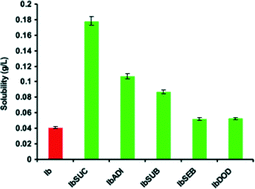
Christer B. Aakeröy, Safiyyah Forbes and John Desper
CrystEngComm, 2014, 16, 5870 DOI:10.1039/C4CE00206G
Systematic structure–property studies on a series of co-crystals of potential cancer drugs with aliphatic dicarboxylic acids were undertaken. This study reveals that systematic changes to the molecular nature of the co-crystallizing agent combined with control over the way individual building blocks are organized within the crystalline lattice makes it possible to establish predictable links between molecular structure and macroscopic physical properties, such as melting behaviour and aqueous solubility. However, it is not possible to find any notable correlation between physical properties and chemical compositions in the absence of structural consistency.
Paper
Altering physical properties of pharmaceutical co-crystals in a systematic manner
*Corresponding authors
aDepartment of Chemistry, Kansas State University, 213 CBC Building, Manhattan, USA
E-mail: aakeroy@ksu.edu;
Fax: +1 785 532 6666 ;
Tel: +1 785 532 6096
E-mail: aakeroy@ksu.edu;
Fax: +1 785 532 6666 ;
Tel: +1 785 532 6096
CrystEngComm, 2014,16, 5870-5877
DOI: 10.1039/C4CE00206G
Monday, 16 June 2014
C–C Coupling Repertoire Grows ... Organic Synthesis: Reaction eases addition of chiral carbon centers to aryl groups

REVIVAL
This new reaction combines chiral secondary and tertiary boronic esters (left) with lithiated aryls to form intermediates that rearrange upon electrophile addition, yielding aryl-alkyl coupling products.
The revival of a nearly 50-year-old technique for forming carbon-carbon bonds may help ease the synthesis of aryl derivatives, such as drug candidates.
Varinder K. Aggarwal and coworkers at the University of Bristol, in England, have taken a venerable but neglected synthesis called Zweifel olefination and made it new again (Nat. Chem. 2014, DOI: 10.1038/nchem.1971).
C–C Coupling Repertoire Grows
Organic Synthesis: Reaction eases addition of chiral carbon centers to aryl groups
http://cen.acs.org/articles/92/i24/CC-Coupling-Repertoire-Grows.html
\SEE ALL AT
\SEE ALL AT
 BRAZIL WORLDCUP WEEK 2014



Wednesday, 11 June 2014
Boronic Acid Catalyzed Annulation of a Pyran Ring
Boronic Acid Catalyzed Annulation of a Pyran Ring
 A route to oxygenated pyrano[3,2-a]- and
pyrano[2,3-a]carbazole alkaloids
A route to oxygenated pyrano[3,2-a]- and
pyrano[2,3-a]carbazole alkaloidsRead more
Subscribe to:
Posts (Atom)