The FDA’s Drug Review Process: Ensuring Drugs Are Safe and Effective « New Drug Approvals:
'via Blog this'

ORGANIC CHEMISTRY INTERNATIONAL............ BY DR ANTHONY MELVIN CRASTO, Helping millions with websites, millions of hits on google. 30 yrs exp in the field of Process development
Saturday, 1 March 2014


Thursday, 27 February 2014
Catalyst Under Stress

The oxidation of water to molecular oxygen is an important reaction in the frame of artificial photosynthesis, solar fuels, and a sustainable energy future. Iridium complexes have recently gained attention as effective precatalysts for this transformation.
To gain deeper understanding of this process, Alceo Macchioni, University of Perugia, Italy, and colleagues aimed at intercepting the intermediates of the oxidative transformation of [Cp*Ir(bzpy)NO3] (Cp* = pentamethylcyclopentadienyl, bzpy = 2-benzoylpyridine), which is a competent catalyst for water oxidation.
read at
http://www.chemistryviews.org/details/ezine/5838331/Catalyst_Under_Stress.html
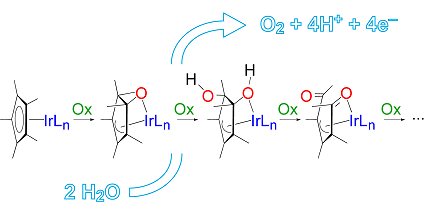
Thursday, 13 February 2014


Wednesday, 29 January 2014
 A magnetic resonance (MR) probe can be used to distinguish old and new blood clots
Saturday, 11 January 2014
Studies of Removal of Indigo Caramine Dye from Water by Formaldehyde and Urea Treated Cellulosic Waste of Citrus reticulata Peels
Citrus reticulata, Orange
Studies of Removal of Indigo Caramine Dye from Water by Formaldehyde and Urea Treated Cellulosic Waste of Citrus reticulata Peels
Asian J. Chem., 2014, 26(1), pp 43-47 | DOI:10.14233/ajchem.2014.15305
Rabia Rehman*, Javaria Zafar and Hina Nisar
*Corresponding author: Fax: +92 42 99230998;
Tel: +92 42 99230463, Ext: 870; E-mail: grinorganic@yahoo.com
The Citrus reticulata (orange) peels has been employed as adsorbents for removing inorganic and organic pollutants from wastewater extensively due to its low cost and eco-friendly nature. This research work concerns with the study of comparative removal of Indigo carmine dye from water using simple, formaldehyde and urea treated Citrus reticulata peels. The effect of adsorption parameters were investigated and maximum sorption capacity was obtained from Langmuir isotherm model at optimized conditions, i.e.: 5.90, 14.79 and 71.07 mg g-1 for simple, formaldehyde treated and urea treated Citrus reticulata peels, respectively.
Feasibility of process is indicated by the values of separation factor, Gibb’s free energy and adsorption intensity ‘n’. The results of present study indicate that Citrus reticulata peels has inherited a lots of capacity for removing anthraquinone type of dyes, which can be further improved by treating with formaldehyde or urea in economical way.
Feasibility of process is indicated by the values of separation factor, Gibb’s free energy and adsorption intensity ‘n’. The results of present study indicate that Citrus reticulata peels has inherited a lots of capacity for removing anthraquinone type of dyes, which can be further improved by treating with formaldehyde or urea in economical way.

Asian Journal of Chemistry
AN INTERNATIONAL PEER REVIEWED RESEARCH JOURNAL OF CHEMISTRY

Inst of Chem Eng , Univ of punjab, Pakistan

OLD CAMPUS
http://www.pu.edu.pk/

INST OF CHEMISTRY, UNIV OF PUNJAB LAHORE PAKISTAN

University of the Punjab, Lahore, Pakistan-54590

LAHORE AT NIGHT
LAHORE FOOD STREET
Thursday, 9 January 2014
Natural product based leads to fight against leishmaniasis
 | ||
The growing incidence of parasitic resistance against generic pentavalent antimonials, specifically for visceral disease in Indian subcontinent, is a serious issue in Leishmania control. Notwithstanding the two treatment alternatives, that is amphotericin B and miltefosine are being effectively used but their high cost and therapeutic complications limit their use in endemic areas. In the absence of a vaccine candidate, identification, and characterization of novel drugs and targets is a major requirement of leishmanial research. This review describes current drug regimens, putative drug targets, numerous natural products that have shown promising antileishmanial activity alongwith some key issues and strategies for future research to control leishmaniasis worldwide


Natural product based leads to fight against leishmaniasis
Review Article
Bioorganic & Medicinal Chemistry,Volume 22, Issue 1, 1 January 2014, Pages 18–45
Nisha Singh, Bhuwan B. Mishra, Surabhi BajpaiRakesh K. Singh, Vinod K. TiwariMolecular Immunology Laboratory, Department of Biochemistry, Faculty of Science, Banaras Hindu University, Varanasi 221005, India , Department of Chemistry, Faculty of Science, Banaras Hindu University, Varanasi 221005, India
VARANASI INDIA


Subscribe to:
Posts (Atom)